
The Scent of Empathy: What the Front Lines Taught Me About you Workout
I fought in the war and coached elite executives for 15 years. Here's Why Your personal trainer's “hustle” is actually killing your progress.

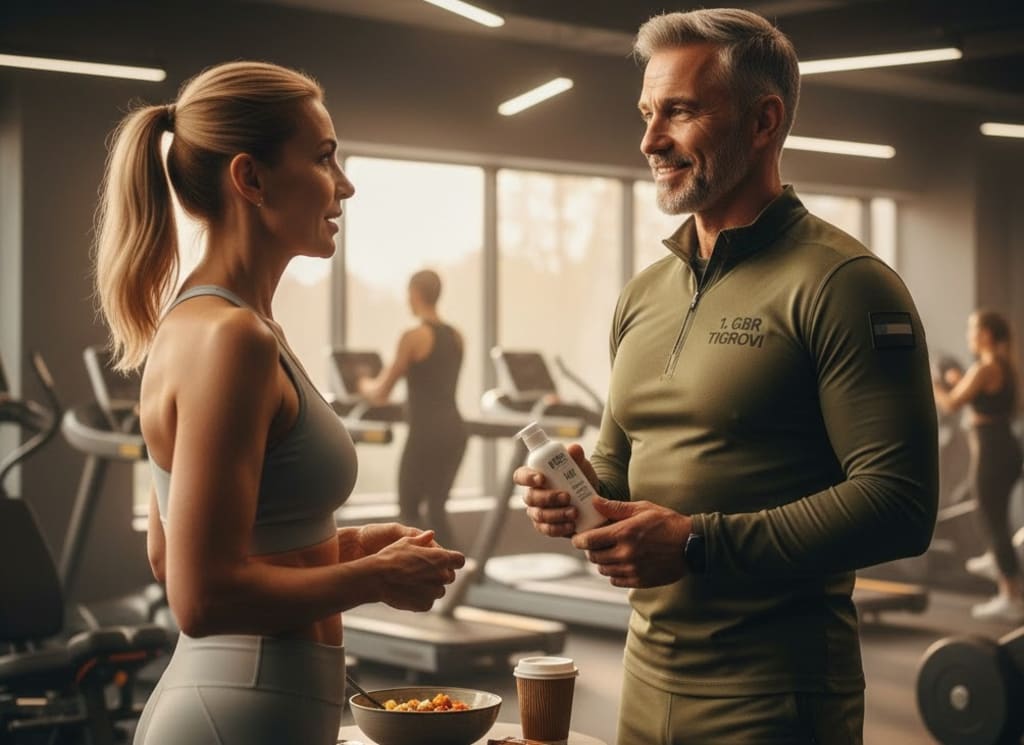
The Battlefield You Don’t See
You’d think that after being a member of the 1st Guards Brigade "Tigers" during the Croatian War of Independence, I’d be the kind of trainer who screams in your face until you puke. You’d expect a drill sergeant in camo pants, barking about "no pain, no gain" and "weakness leaving the body."
But the front lines in 1992 taught me something far more dangerous than how to handle a rifle. They taught me how to read a human being under extreme stress. They taught me the “human scan”—the ability to see when a man is at his breaking point before he even knows it himself.
When I retired on a military disability pension and transitioned into the world of high-end personal training, I realized the fitness industry was fighting the wrong war. They were obsessed with biomechanics, “biceps femoris” activation, and rigid mathematics. They forgot the person behind the reps.
In my 15 years of being “buried alive” with clients—from CEOs to exhausted parents—I realized that for a recreational athlete, the gym isn’t a stadium. It’s a sanctuary. And if you don't treat it that way, you’re just another stressor in an already broken world.
The Myth of the "Perfect" Program
Every day, I see young, over-eager trainers—usually fresh out of a kinesiology degree—bombarding their clients with data. They talk about “eccentric loading” and “caloric deficits” as if they’re programming a computer.
But imagine this: You are a high-level executive. You just spent ten hours in back-to-back meetings. You’ve signed a million-dollar contract on an empty stomach. Your ears are literally ringing from the pressure. You walk into the gym, and some kid starts lecturing you on why you didn't meal prep your broccoli on Sunday night.
That’s not coaching. That’s an assault.
The fitness world lives in a bubble where training is the 24/7 priority. But for my clients, they are "paratroopers" in our world. They’ve dropped in for 60 minutes to save their health, not to win a bodybuilding trophy. My job isn't to make them a mathematician; it’s to be their psychologist with a side of dumbbells.
Earning the Right to Get Close
There is a concept in military medicine and psychology regarding "intimate space." It’s that invisible bubble—about 20 inches—where we feel safe. Most trainers barge into this space like they own it. They touch, they correct, they hover.
Especially with female clients, this is where most male trainers fail. They think their “muscles” are an invitation. They couldn't be more wrong. You have to earn your way into that space.
I’ve always told my staff: Your visual identity is your first rep. If you show up looking like a gym rat in a Siberian gulag—sweaty, unkempt, and smelling like the tuna can you just finished—you’ve already failed.
I have a secret weapon: Hygiene as a psychological tool. I don’t use heavy, aggressive colognes. I use high-end, neutral body lotions—something that smells like a clean pharmacy or a spring breeze. Or, as I often suggest, baby lotion. Why? Because that scent triggers a subconscious nurturing instinct. It signals “safety” instead of “aggression.”
When I reach out to correct a client’s form with moisturized, sanitized hands, it’s not an “attack” on their space. It’s a professional, caring intervention. I want my clients to feel like they are being handled by a pro, not a meathead.
The "One-Man Show" and the Art of the Pivot
I used to run teams, organize events, and even work as a host in high-end clubs. Sometimes I’d have other trainers fill in for me when I was overbooked. The feedback was almost always the same: "He was too hard on me," or "He just didn't get that I was tired."
I eventually fired them all and went back to being a “one-man show." Why? Because you can’t teach "the gut.”
If a client walks in, and I see their shoulders are up to their ears and their eyes are glazed over, the “perfect program” goes in the trash. We don't squat. We don't deadlift. Not yet.
Instead, I’ll make them a protein smoothie or a coffee. We’ll sit for ten minutes. I’ll talk to them like an old friend until I see their breathing normalize and their “sugar” return to their brain. We might lose 15 minutes of “working out,” but we gain an hour of high-quality movement because they are finally present.
Many trainers think this is "wasted time." I call it the most important part of the session. You have to be a virtuoso of the atmosphere. If they leave the gym feeling happier than when they arrived, you’ve won. The weights are secondary.
Less is More: The Psychology of the “Hobbyist”
We need to stop treating recreational clients like pro athletes. They don't have the “mindset” of a competitor, and they shouldn't have to. They are here to survive their stressful lives, not to add more pressure to them.
I’ve seen trainers treat a skipped meal like a moral failing. "Why didn't you eat your chicken and rice?" they ask, with a condescending tone.
They forget that their client was busy keeping a company afloat or a family together.
I’ve often been the one "airplane-feeding" my clients like toddlers—pushing a protein bar or a shake toward them while making a joke, just to get some fuel in their system so they don't collapse. It’s about being a support system, not a judge.
The Final Verdict: Wrapped in a Ribbon
At the end of the day, you have to package yourself as a "gift." Not out of vanity, but out of respect for the client’s investment. They are paying you “fat” money for an experience.
They want to be around someone who is put-together, smells good, speaks with authority but acts with kindness, and—most importantly—listens.
My time in the Tigrovi taught me that authority isn't about shouting; it's about being the person others want to follow into the dark. In the gym, that “darkness” is the client’s own stress, fatigue, and insecurity.
Be the light, not the thunder.
Training isn't a math problem. It’s human connection. And until we start teaching trainers how to be psychologists, we’re just moving iron in a room full of lonely, stressed people.
About the Creator
Feliks Karić
50+, still refusing to grow up. I write daily, record music no one listens to, and loiter on film sets. I cook & train like a pro, yet my belly remains a loyal fan. Seen a lot, learned little, just a kid with older knees and no plan.
Keep reading
More stories from Feliks Karić and writers in Longevity and other communities.
The No-Exercise Cholesterol Hack: How I Ate My Way Out of a Medical Mess
I’ve spent most of my life as an athlete and a soldier, which means I’m used to treating my body like a machine. In that world, you don’t ask how the engine feels; you just put the fuel in and demand results. But hit fifty, throw in a few major surgeries, and suddenly that machine starts looking more like a rusty tractor.
By Feliks Karić3 days ago in Longevity
The Architecture of Signal
It’s common to think of well-being in terms of addition. Energy becomes fuel for long hours. Stamina grows into a tool against setbacks. Endurance becomes persistence when effort persists. Fresh proof of life shows up in sheer volume produced. Strength reveals itself not through stillness, but in load endured, mileage logged, even when muscles protest. What counts is motion sustained beyond comfort, effort stretched past the point breath gives out.
By Dr Marc Nock, DDSabout 5 hours ago in Longevity
Mexico Vegan Beauty Market Analysis Project Value|USD 480.1 Million 2033
Overview Insights- Vegan cosmetics include skincare, haircare, makeup, and other personal care products free from animal-derived ingredients such as beeswax, lanolin, collagen, and keratin. Unlike “cruelty-free” labeling alone, vegan certification focuses on ingredients as well as ethical manufacturing practices.
By Ashutosh Srivastavaa day ago in Longevity


Comments
There are no comments for this story
Be the first to respond and start the conversation.