politics
Politics does not dictate our collective cultural mindset as much as it simply reflects it; We've got to look in the mirror sometimes, and we've got one.
Russia and Ukraine: War or peace?
Russia on February 15 announced that it’s pulling back some troops from the borders of Ukraine in the first clear signal that it was ready for de-escalation. The announcement came hours before Russian President Vladimir Putin met the German Chancellor, Olaf Scholz, in the Kremlin. “Units of the southern and western military districts, having completed their tasks, have already begun loading onto rail and road transport and today they will begin moving to their military garrisons,” the Russian Defense Ministry said in a statement. But the West remained skeptical. A day after the Russian announcement, both NATO and the U.S. said that there were no signs of actual Russian troop pull-back. U.S. President Joe Biden went a step ahead, saying he was “convinced” that Mr. Putin made the decision to attack Ukraine. Allegations of ceasefire violations by both the Ukraine government and the rebels in Eastern Ukraine’s Donbas region raised turned up the heat, with the Pentagon saying the clashes could be the pretext Russia was seeking for an attack. But if one cuts through the clutter of rhetoric, there are “signs of peace”, argued this editorial of The Hindu. While Russia has mobilize over 130,000 troops on the three sides of Ukraine, it has also kept all the diplomatic channels open. And three European leaders and many more diplomats visited Moscow in recent weeks. Of them, the diplomatic interventions made by French President Emmanuel Macron and Germany’s Mr. Scholz were particularly significant. While Mr. Macron took steps to revive the Minsk Accords to address Ukraine’s internal conflict, Mr. Scholz said twice, first in Kiev and then in Moscow, that Ukraine’s entry into NATO is “not on the agenda right now”. In a televised address, U.S. President Joe Biden, who warned Russia of “severe costs”, also said, “Neither the U.S. nor NATO have missiles in Ukraine. We do not — do not have plans to put them there...” Put together, these proposals offer at least solid talking points to push for a diplomatic solution. While the rhetoric of a conflict is still high, all sides remain open to walking down the diplomatic road. India and the world
By Kamlesh Kumar 4 years ago in The Swamp
Sohan. Ruh without non-political stability
On the one hand, it is unfortunate that our nation has become very emotional and on the other hand, there are subversive elements who have not yet wholeheartedly accepted the existence of Pakistan. These people are trying to take unfair advantage of the sentimentality of the people. Whenever there is a political crisis in the country, some quarters try to make people believe that there is a special lobby behind it. These circles also frequently spread such rumors and speculations which created a tsunami of ambiguity among the people. What is the purpose of such mischief, needless to say, the government is aware of these reasons and the well-informed circles are well aware of it. Every word and deed that is said or done for the purpose of spreading sedition and creating an atmosphere of hatred needs to be strictly suppressed. In the current critical period
By Zeeshan Khan4 years ago in The Swamp
WORKERS COMP
State workers' compensation provides medical expenses, lost wages, and rehabilitation costs to employees who are injured or become ill “in the course and scope” of their job. It also pays death benefits to families of employees who are killed on the job.
By CarmenJimersonCross4 years ago in The Swamp
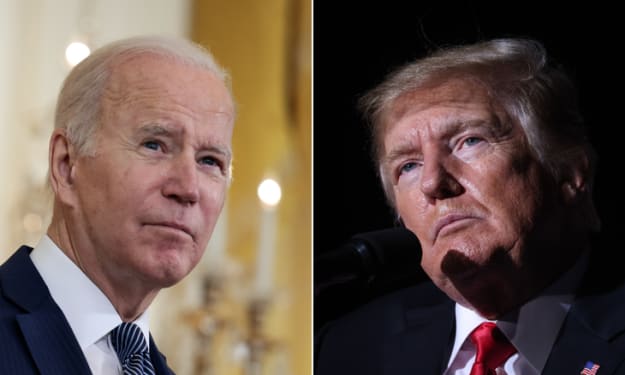
According to a CNN poll, neither Biden nor Trump have the full support of their respective parties for a run in 2024.
According to a recent CNN poll done by SSRS, a large proportion of Democrats and Republicans want their parties to find alternatives to President Joe Biden and former President Donald Trump in the next presidential race. Few, though, have specific candidates in mind, highlighting how far away — and possibly malleable — the 2024 election is.
By Vijay Mistry4 years ago in The Swamp
Is It Apocalypse Now As We Hang On The Edge Of WWIII
Are we living in history? It certainly feels that way to me, and I imagine many people my parent's age or older. While growing up, my generation heard all about the evils of communism from our parents and grandparents. Myself, I lived through the fall of communism and the Berlin wall coming down. The cold war was over and communism, as it was known, failed. Now, we sit on the precibus of war in Eastern Europe. The world has two big questions in front of them. What will U.S. President Joe Biden do? What will Russian President Putin do?
By Jason Ray Morton 4 years ago in The Swamp
MSNBC Fox And Newsweek Went Crazy With This Biden Administration Story About Crack Pipes
Newsweek announced today that the Biden Administration would be handing out free “crack pipes.” The federal government has yet to legalize marijuana for recreational or medicinal use, so handing out crack pipes sounded suspicious to me. Like the good little fact-finder I am, I am sad to announce that this appears to be the truth. But, it’s not the entire story.
By Jason Ray Morton 4 years ago in The Swamp
Why Putin Loses In His Own Game
Introduction After Putin took power in 2000, Russia’s foreign politics was a headache for the world, especially for its smaller neighbors. Russia holds the largest natural resources which are necessary for both the neighbors and the world. Only, for this reason, Putin continues to play his Tsarist games. First, we need to understand that his foreign political views are built on long Russia’s history.
By Arnas Mikonis4 years ago in The Swamp
The Affect of Bureaucratic Authoritarianism
In Brazil the military dictatorship (Bureaucratic Authoritarianism) for all its ills was able to uplift large portions of society and start the shift of Brazil from an exporting agricultural economy into an industrializing consumer economy. It did this by nationalizing and funding country wide programs aimed at modernizing the economy (Petrobras, public education, and massive infrastructure projects to name a few). Primarily using borrowed money from the US, The new anti-communist regime could deliberate internally as to which portions of the economy would be stimulated. Central to the decision making process was the military, which was split into two major camps. The first one being hardliners which wanted to bolster the military budget/control of society and the second being those which were part of the military but, sought to liberalize/delegate/co-opt development projects. With this backdrop in mind, this proposal asks how then did the Authoritarian Bureaucratic regime in Brazil affect pension distribution for those who worked during the era? And what long term social economic effects did the distribution cause? Who got left out?
By Arjuna Fournier4 years ago in The Swamp